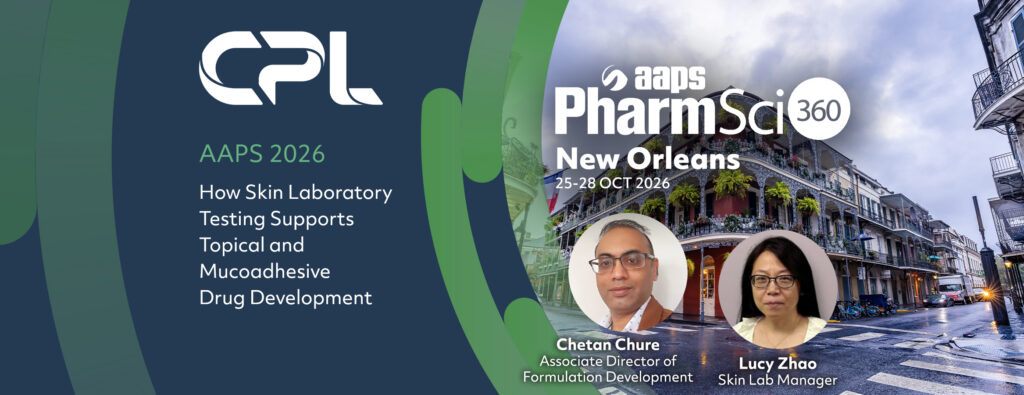
CPL will bring its expertise in skin laboratory testing and pharmaceutical development to AAPS 2026 PHARMSCI 360, taking place October 25–28 in New Orleans, Louisiana. CPL scientists Lucy Zhao and Chetan Chure will present research focused on mucoadhesive formulations, polymer selection, drug release, and in vitro permeation testing.
Their research demonstrates how specialized laboratory models can help pharmaceutical developers evaluate formulation performance earlier in development, select promising prototypes, and generate data that supports more informed formulation decisions.
For developers working with topical, semi-solid, or mucosal drug products, these approaches can provide important insight into how formulations release and deliver an active pharmaceutical ingredient in biological environments.
Why Topical and Mucosal Drug Development Requires Specialized Testing
Topical and mucosal drug products present development challenges that differ from conventional solid dosage forms. Creams, ointments, gels, films, and other formulations depend on interactions among active ingredients, polymers, permeation enhancers, viscosity, particle characteristics, and other formulation components.
The formulation must remain stable and functional while delivering the drug to the intended site at an appropriate level.
For topical products, the skin acts as a critical biological barrier. Developers must understand how much drug reaches the target tissue, how quickly it permeates, and whether the formulation is delivering the desired amount without excessive penetration.
Mucosal drug delivery presents its own challenges. Mucosal tissues have different structural and physiological characteristics than skin, and formulations must often remain at the intended site long enough to provide the desired therapeutic effect.
These factors make skin laboratory testing an important component of topical and mucosal formulation development.
Using IVRT and IVPT to Evaluate Formulation Performance
In vitro release testing (IVRT) and in vitro permeation testing (IVPT) provide formulation developers with valuable information about product performance before programs advance to more costly studies.
IVRT characterizes the rate at which an active pharmaceutical ingredient is released from a topical formulation. The data can help developers compare formulations, evaluate changes, support scale-up and manufacturing site transfers, and address post-approval changes.
IVPT evaluates drug movement through a biological or synthetic membrane. For topical products, IVPT can provide information about drug permeation, delivery to specific skin layers, and differences in performance among formulation prototypes.
CPL’s Skin Lab integrates IVRT, IVPT, and skin distribution analysis to support topical formulation development and product performance evaluation. The laboratory works with formulations including creams, gels, ointments, lotions, films, and transdermal products.
When incorporated early in development, these techniques can help teams eliminate less promising prototypes and focus resources on formulations with stronger performance characteristics.
Evaluating Mucoadhesive Formulations with Biological Membranes
Lucy Zhao’s AAPS poster, “Mucoadhesive Film Formulations Using a Biological Mucosal Membrane In Vitro Permeation Model,” examines the use of a biological mucosal membrane as a barrier for IVPT of mucoadhesive film formulations.
Synthetic membranes can provide useful information during formulation development, but they may not reproduce the interactions between a formulation and a biological mucosal surface. A biological membrane can provide additional insight into how polymers interact with tissue and how formulation characteristics influence permeation and release behavior.
This type of testing can help formulation developers better understand how a mucoadhesive formulation may behave at a mucosal surface, including characteristics such as release kinetics, hydration, and adhesion.
For developers screening multiple prototypes, a biologically relevant model can provide additional information during early formulation development and help identify candidates for further investigation.
Understanding Polymer Selection in Buccal Films
Polymer selection is another important consideration in mucoadhesive drug delivery.
Chetan Chure’s AAPS poster, “Polymer-Driven Mucoadhesion and Release Kinetics in Buccal Films: An In Vitro Evaluation Approach,” examines the performance of different polymers used in buccal film formulations.
Mucoadhesive films must balance several formulation requirements. The formulation needs to adhere to the intended mucosal surface, remain in place for an appropriate period, and release the active ingredient at a rate that supports the desired therapeutic effect.
CPL evaluated multiple polymers to understand differences in performance, including release behavior and mucoadhesive characteristics. IVPT was also used to evaluate formulation performance.
The research highlights why polymer selection must be considered alongside the intended drug delivery objective. The appropriate polymer and formulation design depend on the active ingredient, target site, desired residence time, release profile, and other product-specific requirements.
CPL has previously presented research examining mucoadhesive drug delivery and polymer selection across topical, buccal, and nasal routes, further demonstrating the importance of evaluating formulation performance within the physiological environment where a product is intended to function.
Moving Beyond Basic Release Testing
Traditional release testing may not fully capture the biological interactions that influence performance at a mucosal surface or across skin.
A formulation may demonstrate acceptable release under one set of test conditions but behave differently when evaluated against biological tissue.
Combining formulation development with IVRT, IVPT, and appropriate biological models can provide a more complete understanding of skin performance data. These approaches can help development teams identify formulation differences earlier and focus resources on candidates with the most promising characteristics.
CPL’s analytical and product testing services integrate IVRT and IVPT with broader analytical development and testing capabilities for semi-solid and non-sterile liquid products.
Skin Laboratory Testing Can Support Earlier Formulation Decisions
Skin laboratory testing can provide value throughout topical drug development, but early testing can be particularly useful for prototype selection and formulation optimization.
IVPT can help developers compare initial prototypes and evaluate biological performance before advancing candidates into more resource-intensive stages. IVRT can provide comparative release data that supports formulation development and, for appropriate products, regulatory strategies.
For generic topical products, IVRT and IVPT can also contribute to bioequivalence strategies and comparisons between generic and reference formulations. CPL’s testing capabilities include IVRT method development and validation, IVPT method development, permeation profiling, skin distribution analysis, and testing that supports scale-up and post-approval changes.
This early feedback can help sponsors make decisions about formulation selection, optimization, and product performance before committing significant resources to less promising candidates.
Human Skin Models Provide Relevant Development Data
The biological model selected for testing can also influence the information generated during a study.
Animal skin and human skin have structural differences that can affect permeation results, including differences in skin thickness and the characteristics of the epidermis, dermis, and stratum corneum.
When the development objective is to understand how a topical formulation may perform in humans, human skin models can provide relevant information that may not be captured by synthetic or animal models alone.
CPL’s Skin Lab conducts skin distribution and permeation studies using excised human and animal skin, allowing developers to evaluate drug distribution within specific skin layers as well as drug movement through the tissue.
Connecting Skin Testing to Formulation Development
Skin testing is most valuable when the resulting data can directly inform formulation decisions.
CPL integrates Skin Lab testing with pharmaceutical development services, allowing formulation and testing scientists to work together to evaluate product performance, refine formulations, and support development decisions.
This integrated approach is particularly relevant for complex topical products where formulation characteristics, drug release, permeation, manufacturability, and product quality must be considered together.
CPL’s semi-solid drug product development capabilities extend from formulation design and process development through analytical testing, skin testing, technology transfer, and GMP manufacturing.
The connection between formulation development and skin testing can also help address underperforming products. CPL’s work with topical reformulation programs demonstrates how IVRT and IVPT can be incorporated into efforts to evaluate formulation performance and determine whether changes improve drug release and delivery to the intended skin layer.
Meet CPL at AAPS 2026 PHARMSCI 360
CPL scientists Lucy Zhao and Chetan Chure will present their research at AAPS 2026 PHARMSCI 360, taking place October 25–28, 2026, in New Orleans, Louisiana.
Chetan Chure
“Polymer-Driven Mucoadhesion and Release Kinetics in Buccal Films: An In Vitro Evaluation Approach”
Monday at 12:30 p.m. CST
Forum 1, Monitor 3
Lucy Zhao
“Mucoadhesive Film Formulations Using a Biological Mucosal Membrane In Vitro Permeation Model”
Monday at 3:30 p.m. CST
Forum 10, Monitor 57
Attendees interested in topical drug development, skin laboratory testing, IVRT, IVPT, mucoadhesive formulations, or in vitro permeation models are encouraged to attend both poster presentations and speak directly with the CPL scientists.
The presentations also provide an opportunity to discuss how CPL’s Skin Lab can support formulation screening, optimization, product performance evaluation, and broader pharmaceutical development programs.
Discuss a Skin Laboratory or Formulation Development Program with CPL
The right testing strategy can provide actionable data earlier in development and help sponsors make more informed formulation decisions.
CPL combines specialized skin laboratory capabilities with formulation development, analytical testing, process development, technology transfer, and GMP manufacturing for semi-solid and non-sterile liquid drug products.
Pharmaceutical developers evaluating a topical, semi-solid, transdermal, or mucosal drug product can connect with CPL to discuss formulation challenges, IVRT or IVPT strategies, skin testing requirements, and broader development needs.
Contact CPL to schedule a meeting and discuss how CPL’s Skin Lab and pharmaceutical development capabilities can support the next stage of a drug development program.