Developing topical and transdermal drug products requires more than demonstrating that a formulation contains the correct amount of active pharmaceutical ingredient (API). The formulation must remain homogeneous and stable, release the API at an appropriate rate, and deliver the drug to the intended location in or on the skin.
Those requirements create development challenges that differ from conventional solid oral dosage forms. A tablet or capsule provides a defined unit dose. A semi-solid topical product must maintain consistent performance throughout the formulation and during each application. The formulation must also interact with the skin in a controlled and predictable way.
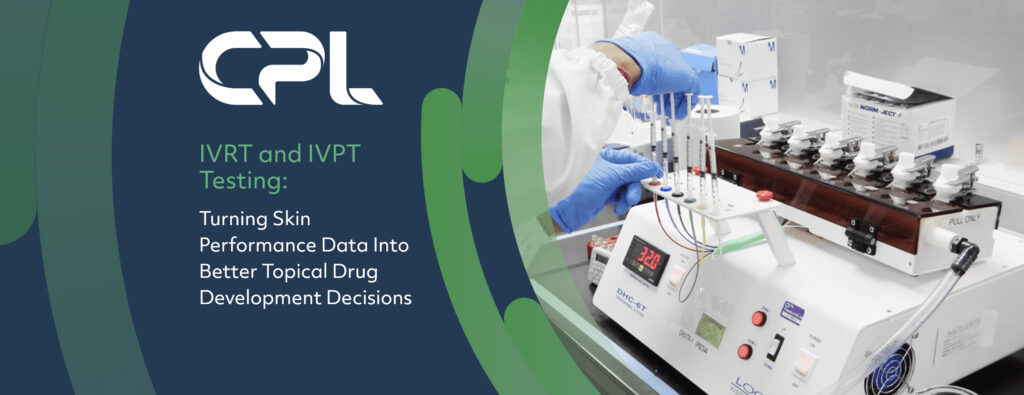
CPL’s Skin Lab uses in vitro release testing (IVRT) and in vitro permeation testing (IVPT) to generate data about topical and transdermal drug performance. These studies can help formulation teams select prototypes, optimize formulations, evaluate process changes, support bioequivalence strategies, and generate data for regulatory submission.
Why Topical Drug Development Requires Specialized Testing
Semi-solid formulations such as creams, gels, ointments and lotions present unique development considerations. The formulation must remain homogeneous and physically and chemically stable while delivering the API consistently during use.
Drug delivery through the skin adds another layer of complexity. The skin acts as a biological barrier, and the desired therapeutic effect can depend on where the API is distributed.
Some topical products are designed to deliver an API to a specific skin layer. Others are designed to limit penetration beyond the skin surface. Formulation composition, excipient selection, rheology and manufacturing processes can all influence these outcomes.
Patient acceptability also matters. Texture, feel, spreadability and appearance can influence whether a patient is willing to apply a product as directed.
CPL’s expertise in semi-solid drug product development addresses these considerations from formulation through manufacturing, while integrated analytical and Skin Lab capabilities provide additional information about product performance.
What Is the Difference Between IVRT and IVPT?
IVRT and IVPT answer different questions about topical and transdermal drug performance.
In vitro release testing (IVRT) evaluates how an API is released from a formulation. A topical or transdermal formulation is separated from a receptor medium by a synthetic membrane. Samples are collected over time and analyzed to establish the rate at which the API is released from the formulation.
In vitro permeation testing (IVPT) evaluates how an API moves through biological tissue. The formulation is applied to excised skin or another biological membrane, and the movement of the API through the tissue is measured over time. IVPT can also provide information about drug distribution within specific tissue layers.
The distinction is important.
IVRT primarily evaluates drug release from the formulation.
IVPT evaluates drug permeation through biological tissue and distribution within or across the target tissue.
Together, IVRT and IVPT provide complementary information that can help developers understand both formulation performance and drug delivery.
IVRT Measures Formulation Performance
IVRT can help determine whether a formulation releases its API at an appropriate and consistent rate.
During formulation development, IVRT can help scientists understand how changes to formulation composition affect drug release. For generic development, IVRT can also be used to compare the release behavior of a test formulation with a reference product.
The value of IVRT extends beyond initial formulation screening. The testing can support scale-up, manufacturing site transfers, and post-approval changes by helping demonstrate that changes to formulation, equipment, process, or manufacturing scale have not altered product performance.
CPL’s analytical method development capabilities include IVRT method development and validation for semi-solid products. These methods can provide data for comparing lab, pilot and commercial batches and evaluating changes associated with scale-up and technology transfer.
IVPT Shows Where the Drug Goes
IVPT addresses a different development question: Does the formulation deliver the API to the intended location?
A topical drug may need to reach the epidermis, dermis or another target tissue layer. In other cases, minimizing penetration beyond the skin surface may be the desired outcome.
IVPT can measure permeation profiles and help determine drug distribution across skin layers. CPL’s Skin Lab uses skin and mucosal tissue in diffusion-cell systems to evaluate the movement of APIs through biological barriers.
The information generated through IVPT can be particularly valuable during formulation screening.
A development program may begin with multiple prototype formulations that appear acceptable based on conventional analytical and physical testing. IVPT can provide another layer of information by showing which formulations demonstrate the desired permeation or distribution profile.
That data can help a formulation team narrow the prototype pool and focus additional development work on the most promising candidates.
IVRT and IVPT Connect Formulation Decisions to Drug Performance
Formulation development often involves changes to excipients, drug loading, rheology, vehicle composition or process parameters. Conventional testing can show whether those changes affect physical or chemical properties. IVRT and IVPT can help determine whether the changes also affect drug delivery performance.
A formulation change may produce an acceptable assay and physical appearance while altering the rate at which the API is released. IVRT can identify that change.
Another formulation may demonstrate acceptable release characteristics but fail to deliver the API to the intended skin layer. IVPT can provide information that identifies that performance difference.
CPL integrates IVRT and IVPT with formulation and analytical capabilities so that testing results can directly inform subsequent development decisions. CPL’s product and formulation development capabilities include IVPT, IVRT, prototype development, characterization and process development.
Method Development Is Critical to Reliable IVRT and IVPT Data
Generating IVRT or IVPT data does not automatically produce meaningful development information. The test method must be capable of detecting relevant differences in the formulation or manufacturing process.
Semi-solid formulations can be particularly sensitive to manufacturing conditions. Changes to process parameters can affect the structure and distribution of components within the formulation, which can subsequently affect drug release.
Method sensitivity is therefore critical. A robust method should detect meaningful differences while demonstrating appropriate consistency when the manufacturing process remains controlled.
IVRT and IVPT also involve multiple experimental variables, including membrane or tissue selection, receptor medium, sampling conditions, temperature, diffusion-cell configuration and analytical methodology.
CPL’s Skin Lab uses Franz diffusion cells and other diffusion-cell systems, along with HPLC and UPLC analytical capabilities, to evaluate drug release and permeation. CPL also provides IVPT method development and IVRT method development and validation.
IVRT Support Scale-Up and Post-Approval Changes
The value of IVRT testing extends beyond early formulation development.
IVRT can support development activities associated with scale-up, manufacturing site transfers, and post-approval changes. These applications are particularly relevant for semi-solid products because changes to equipment, manufacturing scale or process parameters can affect product performance.
A formulation that performs well at laboratory scale must continue to demonstrate consistent performance as manufacturing moves to larger equipment and different operating conditions. IVRT can help determine whether those changes have affected the drug release profile.
CPL addresses these challenges through an integrated development model that connects formulation, analytical and process development. Its approach to semi-solid scale-up emphasizes early process understanding and control of variables that can affect product quality and performance.
IVPT Can Help Guide Prototype Selection
One of the most valuable applications of IVPT is its ability to provide formulation teams with biological performance data during prototype selection.
A development program may generate numerous candidate formulations. Standard analytical testing can eliminate formulations based on assay, impurities, physical stability, phase separation or other characteristics. IVPT adds information about how effectively those formulations deliver the API through the relevant biological barrier.
The resulting data can help distinguish between formulations that appear similar based on conventional testing but perform differently in terms of permeation or drug distribution.
CPL’s Skin Lab can work directly with formulation scientists to evaluate prototype performance and use the resulting data to guide formulation optimization. CPL’s current semi-solid capabilities include IVRT, IVPT, skin distribution studies, analytical testing, process development and scale-up.
CPL Extends IVPT Expertise to Mucosal Drug Delivery
CPL’s permeation testing expertise extends beyond conventional skin models.
The Skin Lab also supports studies involving mucosal membranes, providing additional models for drug delivery systems where permeation across a mucosal barrier is an important consideration.
CPL’s work in this area was presented at 2025 AAPS PharmSci360, where research by Lucy Zhao was selected for the AAPS Special Poster Collection. The research poster, “High-Throughput In Vitro Permeation Models for Comparative Assessment of Mucoadhesive Formulations,” evaluated high-throughput in vitro permeation models for mucosal drug delivery.
The research used MatTek 3D human respiratory epithelial tissues and porcine intestinal membranes to compare mucoadhesive formulations and evaluate how different polymers affected drug release and permeation. The study demonstrated the use of in vitro permeation models to compare formulation performance in mucosal drug delivery systems. CPL’s published research summary also reports differences between hydroxypropyl cellulose (HPC) and hydroxyethyl cellulose (HEC) formulations, with the formulations demonstrating different release and permeation profiles.
Download the AAPS research poster: “High-Throughput In Vitro Permeation Models for Comparative Assessment of Mucoadhesive Formulations” by filling out the form below.
The research demonstrates how CPL applies in vitro permeation expertise to drug delivery systems beyond conventional topical products.
Integrated Skin Testing Reduces Development Handoffs
CPL’s Skin Lab operates within a broader pharmaceutical development and manufacturing environment. Formulation development, analytical testing, skin testing, and manufacturing capabilities are available within the same organization.
That integration allows formulation and Skin Lab scientists to work directly together when IVRT or IVPT results identify an unexpected performance characteristic.
The result is a tighter feedback loop between formulation development and product performance testing. A formulation can be adjusted, retested and evaluated without the delays associated with transferring samples and information between unrelated organizations.
CPL’s approach to scientifically driven semi-solid development combines formulation science, analytical testing, IVRT/IVPT methodologies and scalable manufacturing to support topical product development.
CPL also provides third-party IVRT and IVPT testing for products developed or manufactured outside CPL. Sponsors can use the Skin Lab for specialized testing even when the broader formulation or manufacturing program is being conducted elsewhere.
IVRT and IVPT Provide Data for Better Development Decisions
Topical and transdermal drug development depends on understanding more than formulation composition. Developers need to know how the formulation releases its API, how the API interacts with biological tissue, and whether the drug reaches the intended location at the intended rate.
IVRT and IVPT provide complementary data to answer those questions.
IVRT measures release from the formulation. IVPT measures permeation through biological tissue and drug distribution. Used together with conventional analytical testing, these studies can provide formulation teams with a more complete understanding of product performance.
CPL combines Skin Lab expertise with formulation development, analytical testing, process development, scale-up and GMP manufacturing capabilities. CPL’s integrated pharmaceutical development services connect formulation, analytical and manufacturing activities so that product performance data can inform decisions throughout development.
Partner With CPL for IVRT and IVPT Testing
Selecting the right IVRT or IVPT testing strategy can influence formulation selection, development timelines, scale-up decisions and regulatory planning.
CPL provides specialized IVRT testing, IVPT testing, skin distribution analysis and method development for topical, transdermal and mucosal drug delivery programs. With Skin Lab scientists working alongside formulation, analytical and manufacturing teams, CPL connects product performance data to the broader development program.
Sponsors developing topical, transdermal or semi-solid drug products can contact CPL to discuss their IVRT or IVPT requirements. Schedule a meeting with CPL to determine how Skin Lab testing can generate the data needed to select formulations, evaluate product performance, and advance the next stage of development.