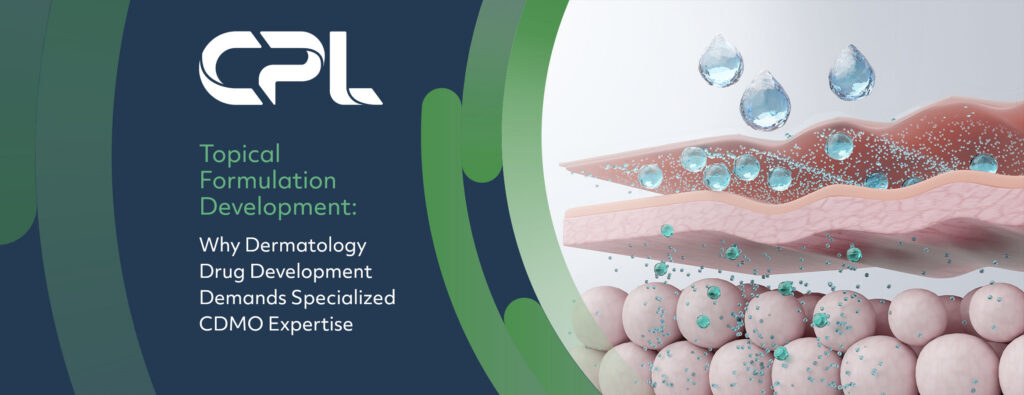
Dermatological drug-product development involves interdependent challenges in formulation design, physicochemical characterization, bio performance testing, process development, and manufacturing control. Unlike oral dosage forms, which are exposed to gastrointestinal dissolution, transit, and first-pass considerations, or parenteral products, which provide direct systemic administration, topical formulations must partition from the vehicle into the stratum corneum, diffuse across or within cutaneous layers, and achieve therapeutically relevant drug concentrations at the intended local site of action while controlling systemic exposure.
That requires more than a formulation containing the right active pharmaceutical ingredient (API). Developers must understand the chemistry of the API, the properties of the formulation, the structure of the skin, drug release and permeation, and how manufacturing processes can affect product performance. The formulation must also remain stable, reproducible, and scalable as the program advances from laboratory development to clinical and commercial manufacturing.
For pharmaceutical companies developing creams, gels, ointments, lotions, and other topical products, specialized CDMO expertise can help address these challenges earlier and reduce risks associated with development and scale-up.
The Skin Barrier Creates a Unique Drug Delivery Challenge
The skin is designed to prevent foreign substances from entering the body. That protective function creates a fundamental challenge for topical drug development: the drug must be formulated to overcome or navigate the skin barrier while reaching the intended site of action.
The formulation must account for the properties of the API and the characteristics of the skin. Molecular size, pH, partition coefficient, charge state, particle size, solubility, and other physicochemical properties can influence whether and how a drug moves through the skin.
Formulation scientists may also evaluate solvents, excipients, and permeation-enhancing technologies to improve drug delivery. The appropriate approach depends on the API, the target site, the desired delivery profile, and the indication.
The formulation must also be appropriate for the intended patient population. An excipient or solvent that improves API solubility may not be appropriate if it causes irritation or otherwise compromises the product.
CPL develops topical and semi-solid formulations by balancing solubility, stability, release, skin permeation, and manufacturability across creams, ointments, gels, lotions, and other semi-solid dosage forms.
Topical Formulation Development Requires More Than API Solubility
API solubility is only one consideration in topical formulation development. A successful formulation must also permeate into the skin thereby delivering the API to target location, maintain physical and chemical stability, , provide consistent dosing, and exhibit the required release characteristics.
Semi-solid products introduce additional complexity because their performance depends on characteristics such as rheology, microstructure, emulsion or suspension stability, and API distribution within the formulation.
These properties are interconnected. A change in excipient concentration, processing conditions, or API distribution can affect the finished product’s performance.
The development process therefore requires an understanding of both pharmaceutical chemistry and skin delivery. Formulation scientists must determine which combination of API, excipients, and processing conditions can produce the desired therapeutic performance while maintaining product quality and stability.
When a topical drug product underperforms, identifying the root cause requires a detailed evaluation of formulation composition, excipient compatibility, stability, skin performance, and process conditions. A systematic approach to reformulating underperforming topical products can help address these issues while maintaining the product’s performance, scalability, and regulatory pathway.
Specialized Expertise Connects API Chemistry With Skin Delivery
The chemistry of the API can determine how difficult a topical formulation will be to develop.
Molecular size can influence skin permeation. The pH of a formulation can affect the ionization state of an API and, consequently, its ability to move through the skin. Particle size can influence formulation behavior and drug delivery. Solvents and excipients can affect both API stability and skin compatibility.
Permeation enhancers can also be considered when appropriate. Specialized delivery systems may provide additional options for transporting an API through the outer layers of the skin.
The formulation strategy must account for these variables simultaneously. Selecting an excipient solely because it improves solubility does not address whether the resulting formulation is stable, manufacturable, tolerable, or capable of delivering the API to the intended site.
That level of evaluation requires specialized semi-solid drug development expertise rather than a formulation approach focused on a single attribute.
Determining Whether a Topical Drug Reaches the Target Site
A topical formulation cannot be evaluated solely by examining the finished product. Developers also need to understand what happens after the formulation is applied to the skin.
In vitro permeation testing (IVPT) provides data on how a drug moves into and through skin over time. It can also help determine drug distribution within specific skin layers.
This information allows formulation scientists to compare prototypes and determine which formulations are best positioned to deliver the API to the intended site.
IVPT can be particularly valuable during early formulation development when multiple prototypes are under consideration. Rather than advancing every formulation through subsequent development activities, developers can use permeation and distribution data to narrow the formulation set and focus additional stability and analytical work on the strongest candidates.
CPL’s Skin Lab integrates skin testing with formulation and analytical development to support topical and transdermal product development.
IVRT and IVPT Answer Different Development Questions
IVRT and IVPT provide different types of information and play complementary roles in topical drug development.
IVPT evaluates permeation through biological tissue and can help determine whether a formulation is delivering the drug to the desired skin layer. During formulation screening, IVPT data can help distinguish between prototypes and evaluate the effects of variables such as excipient selection and permeation-enhancing strategies.
IVRT evaluates drug release from the formulation. Once a formulation has demonstrated the desired delivery characteristics, IVRT can help characterize its release profile and provide information about formulation and manufacturing consistency.
The two tests therefore address different questions.
IVPT can help answer: Is the drug reaching the intended location in the skin?
IVRT can help answer: Is the drug being released from the formulation in a consistent and appropriate manner?
Using both approaches can give development teams a more complete understanding of topical product performance.
CPL performs IVRT and IVPT within its Skin Lab, allowing formulation and skin-testing scientists to work together during development rather than relying on an external laboratory for critical performance data.
Evaluating how a topical formulation interacts with the skin is an important part of development, particularly when the goal is to understand drug release, permeation, and distribution. IVRT and IVPT testing for topical drug development can provide the data needed to compare formulations, identify lead candidates, and make more informed development decisions before advancing to later stages.
IVRT Can Help Monitor Scale-Up
IVRT has an important role beyond early formulation screening.
As a semi-solid formulation moves from laboratory development to pilot and commercial manufacturing, changes in equipment and process parameters can affect the product’s microstructure and release behavior.
IVRT can be used to compare product performance as the manufacturing process and scale changes. Consistent release profiles provide evidence that the product continues to perform as expected as the process moves between scales.
For topical products, maintaining the intended microstructure can be critical. Changes in mixing, shear, temperature, ingredient addition, or other manufacturing as well as packaging process conditions can affect the finished product even when the formulation composition remains unchanged.
Manufacturing Must Be Considered During Formulation Development
A formulation that performs well at laboratory scale is not automatically ready for commercial production.
Semi-solid manufacturing involves process variables that can affect critical quality attributes. Mixing speed, temperature, homogenization, ingredient addition, and processing time can influence the product’s physical structure and performance.
If a development process is designed without considering commercial equipment and manufacturing requirements, problems can emerge during scale-up. A process that works at laboratory scale may need to be redesigned when transferred to pilot or commercial equipment, and this may create additional development work, increase costs and extended timelines.
CPL considers commercial manufacturability during development so that laboratory processes are established with pilot and commercial production in mind. The approach connects formulation development with process development, scale-up, analytical testing, and GMP manufacturing.
Semi-solid formulation scale-up requires development decisions to account for manufacturing from the beginning. Formulation composition, process parameters, equipment, mixing, and other critical variables can behave differently as batch size increases, making early attention to manufacturability essential for maintaining product quality and performance through clinical and commercial production.
Scale-Up Is a Formulation Challenge as Well as a Manufacturing Challenge
Scale-up is not simply a matter of increasing batch size.
For topical and semi-solid products, changes in equipment geometry, mixing, shear, temperature control, and processing time can alter the product’s microstructure and other critical quality attributes.
A development partner must understand how those variables translate between laboratory, pilot, and commercial equipment.
This is why critical process parameters need to be considered during topical formulation development. Establishing the relationship between process parameters and critical quality attributes helps development teams understand which variables must remain controlled as batch size increases.
CPL uses process development, risk assessment, Design of Experiments, and scale-up studies to establish robust manufacturing processes for semi-solid drug products.
CPL also provides additional guidance on critical process parameters for topical semi-solid products, including how process conditions can influence product quality and performance.
Disconnected Development Activities Can Create Avoidable Risk
Topical drug development requires multiple technical disciplines. Formulation scientists need to understand analytical results. Skin-testing scientists need to understand the formulation being evaluated. Manufacturing teams need to understand the process and product characteristics established during development.
When those activities are divided among disconnected organizations, information can be lost between handoffs.
A development group may create a formulation without considering how it will be manufactured at commercial scale. A testing laboratory may generate data without direct access to the scientists responsible for formulation decisions. A manufacturing organization may then receive a process that was never designed around its equipment.
Each handoff creates an opportunity for delays, additional testing, process changes, or redevelopment.
An integrated CDMO model keeps the relevant scientific teams connected throughout development. CPL brings formulation, analytical, skin testing, process development, technology transfer, and clinical and commercial manufacturing together within one organization.
Specialized CDMO expertise is critical because semi-solid formulation development, topical drug product performance, and manufacturing scale-up cannot be treated as separate activities. An experienced CDMO should understand how formulation composition, process parameters, skin performance, and manufacturing requirements interact so potential problems can be identified before they become costly development delays.
Experience Matters When Topical Products Move Toward Commercialization
Dermatology drug development involves technical challenges that are difficult to anticipate without relevant experience.
The interaction between API chemistry, excipients, skin permeation, formulation microstructure, analytical methods, and manufacturing conditions can create problems that are not apparent during early development.
Experience with topical products helps development teams recognize potential issues and incorporate appropriate risk assessments before those issues affect later-stage development.
CPL has more than three decades of experience supporting semi-solid and non-sterile liquid drug products. Its teams work across formulation development, analytical development, skin testing, process development, scale-up, GMP manufacturing, packaging, and commercialization.
That experience also extends to complex topical products that require specialized handling, processing, or packaging considerations.
A Single Development Partner Provides Continuity
Continuity matters when a topical product advances through multiple development stages.
A dedicated project manager can maintain oversight as a program moves from early formulation work through toxicology batches, clinical manufacturing, scale-up, validation, and commercialization. The scientific knowledge developed during early formulation work remains connected to subsequent manufacturing activities rather than being recreated during each transition.
CPL’s integrated model is designed to maintain that continuity. Formulation, analytical, skin testing, process development, manufacturing, and packaging capabilities operate within the same organization.
This structure also creates direct communication between scientific teams. When formulation or analytical data identify an issue, the relevant teams can evaluate the findings together and determine whether changes are needed before the program advances.
CPL’s resource on commercial technology transfer for semi-solid products provides additional insight into how an integrated approach can help manage risk as products transition from development into commercial manufacturing.
Specialized Dermatology Expertise Can Reduce Development Risk
The right CDMO can contribute more than manufacturing capacity to a dermatology development program.
Specialized expertise can help determine how an API should be formulated into a topical dosage form, how the formulation interacts with the skin, which prototypes warrant further development, how release and permeation should be evaluated, and how the process can be scaled without changing product performance.
For pharmaceutical companies developing topical drug products, those decisions can affect development timelines, manufacturing readiness, and the ability to move efficiently into clinical and commercial production.
CPL combines specialized semi-solid formulation expertise with in-house IVRT and IVPT testing, analytical development, process development, scale-up, and GMP manufacturing. The integrated model allows development teams to evaluate formulation performance while keeping downstream manufacturing requirements in view.
Frequently Asked Questions About Dermatology Drug Development
What makes dermatology drug development different from other drug development programs?
Dermatology drug development requires a formulation to overcome the skin’s natural barrier and deliver the API to a specific site of action. Developers must consider API chemistry, molecular size, pH, solubility, permeation, formulation microstructure, drug release, stability, patient use, and manufacturability.
Why is specialized expertise important for topical drug formulation development?
Topical formulations require an understanding of both pharmaceutical formulation science and skin delivery. Changes to APIs, excipients, processing conditions, or formulation characteristics can affect drug release, permeation, stability, rheology, and manufacturability. Specialized expertise helps development teams evaluate those variables as an interconnected system.
What are the biggest challenges in semi-solid formulation development?
Common challenges include API solubility and stability, excipient compatibility, rheology, microstructure, emulsion or suspension stability, drug release, skin permeation, dose uniformity, and scale-up. The formulation also must remain stable and reproducible throughout its intended shelf life.
What is the difference between IVRT and IVPT?
IVRT measures the release of an API from a topical formulation through a membrane, while IVPT evaluates how the API permeates through biological skin tissue. IVRT can help characterize release and support scale-up and manufacturing comparisons. IVPT can help evaluate skin permeation and drug distribution.
How does IVPT support topical drug development?
IVPT can help developers determine how a drug moves through skin and whether a formulation is delivering the API toward the intended skin layer. The resulting data can help rank formulations, evaluate excipients and permeation strategies, and guide formulation selection /optimization.
How does IVRT support topical drug development and scale-up?
IVRT provides information about drug release from a semi-solid formulation. During scale-up, IVRT can help compare formulations manufactured at different scales and identify whether changes in equipment or process conditions have affected product release.
Why is scale-up challenging for topical and semi-solid drug products?
Semi-solid products can be sensitive to changes in mixing, shear, temperature, homogenization, cooling, ingredient addition, and equipment. A process that works at laboratory scale may not produce an equivalent product at pilot or commercial scale unless these variables are understood and controlled.
What should pharmaceutical companies look for in a dermatology CDMO?
Sponsors should look for experience with topical and semi-solid formulations, formulation development, analytical testing, IVRT and IVPT, process development, scale-up, GMP manufacturing, packaging, and technology transfer. An integrated development model can also reduce the risks associated with transferring a product between disconnected organizations.
Why is integrated formulation and manufacturing expertise important for topical drug development?
Formulation and manufacturing decisions are closely connected for semi-solid products. A formulation developed without consideration for commercial equipment may require redevelopment during scale-up. An integrated CDMO can evaluate manufacturability earlier and maintain continuity as the product moves from laboratory development through clinical and commercial manufacturing.
How can a CDMO help move a topical drug product from formulation development to commercial manufacturing?
A CDMO can support formulation development, analytical testing, skin performance testing, process development, scale-up, clinical manufacturing, technology transfer, validation, and commercial production. Maintaining continuity across these activities can help reduce handoffs, preserve product knowledge, and identify development risks earlier.
Partner With CPL for Dermatology Drug Development
Dermatology drug development demands specialized knowledge of skin delivery, formulation science, analytical testing, process development, and scalable manufacturing.
A successful program must address those requirements as interconnected parts of the same development process.
CPL supports topical and semi-solid drug products from formulation development through clinical and commercial manufacturing. With integrated formulation, analytical, IVRT, IVPT, process development, scale-up, manufacturing, and packaging capabilities, CPL can support programs at multiple stages of the product lifecycle.
Pharmaceutical companies developing a dermatology or topical drug product can schedule a meeting with CPL to discuss formulation challenges, development goals, skin-testing requirements, scale-up considerations, and a path toward clinical or commercial manufacturing.