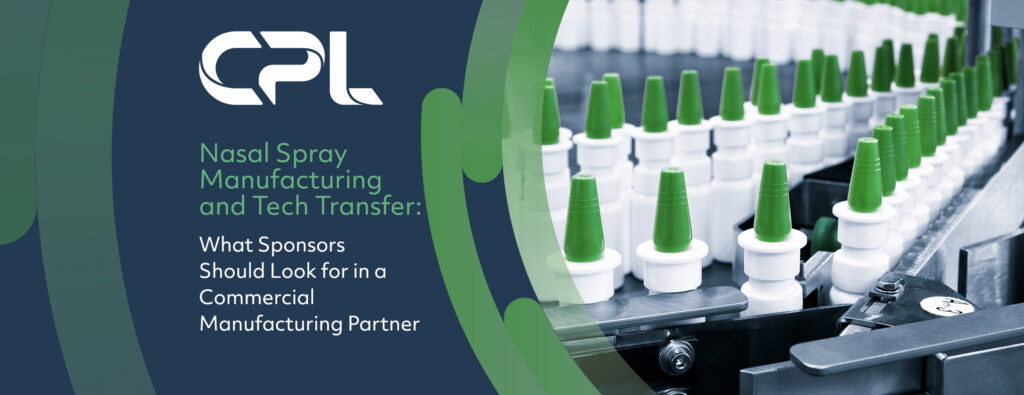
Nasal spray products present unique manufacturing and commercialization challenges that extend beyond traditional liquid dosage forms. As drug-device combination products, nasal sprays require careful coordination between formulation development, manufacturing processes, packaging systems, device performance, analytical testing, and commercial supply chain management.
For pharmaceutical companies preparing to launch a nasal spray product or transfer an existing product to a new manufacturing partner, selecting the right contract development and manufacturing organization (CDMO) can have a direct impact on product quality, regulatory success, supply reliability, and long-term commercial performance.
CPL supports nasal spray programs across the product lifecycle, from formulation development and clinical manufacturing through commercial production and technology transfer.
Nasal Spray Manufacturing Requires More Than Filling a Bottle
Unlike many oral liquid products, nasal sprays combine a drug formulation with a delivery device that must perform consistently throughout the product’s shelf life.
Success depends on controlling both the pharmaceutical and device-related aspects of manufacturing. Factors such as spray pattern, plume geometry, droplet size distribution, dose uniformity, closure integrity, and pump performance all contribute to the final product’s effectiveness.
Many nasal spray formulations also contain hygroscopic polymers or suspension-based systems that require specialized handling and processing. Raw material management, equipment selection, mixing dynamics, shear control, and environmental controls can all influence final product quality.
Manufacturing partners must understand how formulation characteristics interact with process parameters to ensure consistent commercial-scale production.
Critical Quality Attributes Must Remain Consistent from Development Through Commercial Supply
Commercial success depends on maintaining tight control over critical quality attributes throughout manufacturing and packaging operations.
For suspension-based nasal sprays, particle size distribution and rheological properties play an important role in product performance. Variations in these attributes can impact spray characteristics, dose delivery, and patient experience.
Spray pattern and plume geometry must remain within defined specifications to ensure proper deposition within the nasal cavity. Spray content uniformity is equally important. Every actuation must deliver the intended dose from the first spray through the final labeled spray count.
Additional considerations include product stability, container closure integrity, microscopy characteristics, API dissolution behavior, and in vitro bioequivalence requirements that continue to receive increased regulatory attention.
These requirements demand robust process controls, specialized analytical capabilities, and manufacturing experience specific to nasal spray products.
Packaging Complexity Often Becomes a Commercialization Challenge
Many sponsors focus heavily on formulation development while underestimating the complexity of commercial packaging operations.
Nasal spray products frequently require precise filling of small volumes into specialized containers. Packaging systems may include pumps, applicators, protective components, secondary packaging elements, inserts, serialization requirements, and aggregation processes.
Proper torque application, crimping, closure integrity, and priming performance can directly affect product quality and functionality. Even minor variations during assembly may impact device performance or product stability.
Commercial manufacturing partners must have packaging equipment capable of handling these complex systems while maintaining efficiency, accuracy, and compliance.
The ability to integrate filling, assembly, inspection, serialization, and packaging into a seamless operation becomes increasingly important as production volumes grow.
Technology Transfer Success Begins with Process Understanding
Successful nasal spray technology transfer requires more than reproducing an existing manufacturing process.
A comprehensive evaluation must begin with understanding the active pharmaceutical ingredient, formulation characteristics, process requirements, and critical process parameters. Equipment selection must align with the product’s physical properties, sensitivity to shear, mixing requirements, and oxygen exposure limitations.
For oxidation-sensitive formulations, nitrogen blanketing, vacuum capabilities, degassing processes, and aeration control strategies may be necessary components of the manufacturing process.
Analytical readiness is equally important. Sponsors should evaluate whether a CDMO has the in-house testing capabilities required to support release testing and ongoing commercial production.
Early identification of process gaps, equipment requirements, and analytical needs helps reduce transfer risks and accelerate commercialization timelines.
What to Look for in a Nasal Spray CDMO
Selecting a CDMO for nasal spray manufacturing requires evaluating more than available capacity.
Experience with drug-device combination products is critical. Manufacturing partners should demonstrate expertise in formulation processing, filling operations, device assembly, packaging integration, analytical testing, and commercial supply management.
Supply chain strength also plays an important role. Established relationships with leading nasal spray component suppliers help reduce sourcing risks and support production continuity.
Equally important is the ability to scale manufacturing as market demand grows.
CPL has successfully transferred nasal spray programs from smaller manufacturing scales to larger commercial-scale operations, helping sponsors increase production capacity while maintaining product quality and process consistency.
The ability to support development, scale-up, registration batches, commercial manufacturing, and ongoing supply from a single organization simplifies project management and reduces operational complexity.
Integrated Analytical Testing Supports Long-Term Commercial Success
Analytical testing should not be treated as a separate activity from manufacturing.
An integrated approach allows testing, manufacturing, packaging, and release activities to remain aligned throughout the product lifecycle. This reduces project complexity for sponsors while improving efficiency and communication.
When analytical expertise is closely connected to manufacturing operations, potential issues can be identified earlier, investigations can proceed faster, and product release timelines can be streamlined.
For outsourcing teams managing multiple programs, reducing the number of external vendors involved in a project can significantly improve execution and oversight.
Experience Matters in Commercial Nasal Spray Manufacturing
Nasal spray products require specialized expertise, dedicated infrastructure, and a deep understanding of both formulation and device performance.
Commercial manufacturing partners must be capable of managing complex technology transfers, supporting analytical requirements, scaling production, maintaining supply chain continuity, and delivering consistent product quality year after year.
With more than 35 years of manufacturing experience, specialized nasal spray capabilities, integrated development and analytical services, scalable manufacturing infrastructure, and a collaborative approach to customer partnerships, CPL supports sponsors at every stage of the product lifecycle.
Whether a program is in early development, preparing for registration, expanding commercial capacity, or transitioning from another manufacturing site, CPL provides the expertise and infrastructure required to move projects forward with confidence.
Partner with CPL for Nasal Spray Manufacturing and Technology Transfer
Commercializing a nasal spray product requires more than manufacturing capacity. It requires a partner with the technical expertise, equipment, analytical capabilities, packaging knowledge, and commercial experience to support long-term success.
CPL works closely with pharmaceutical companies to evaluate technology transfer opportunities, identify scale-up strategies, and build manufacturing solutions that align with commercial objectives.
Organizations seeking a reliable partner for nasal spray development, technology transfer, commercial manufacturing, or supply chain support are encouraged to contact CPL to schedule a meeting and discuss project requirements with the team.