Topical drug products present unique formulation and manufacturing challenges that can become more difficult as development progresses. Formulations that perform well in the laboratory often require significant refinement before they can be manufactured consistently at commercial scale. For pharmaceutical companies developing creams, gels, ointments, lotions, foams, and other semisolid dosage forms, development decisions made early in a program can directly affect manufacturing success later.
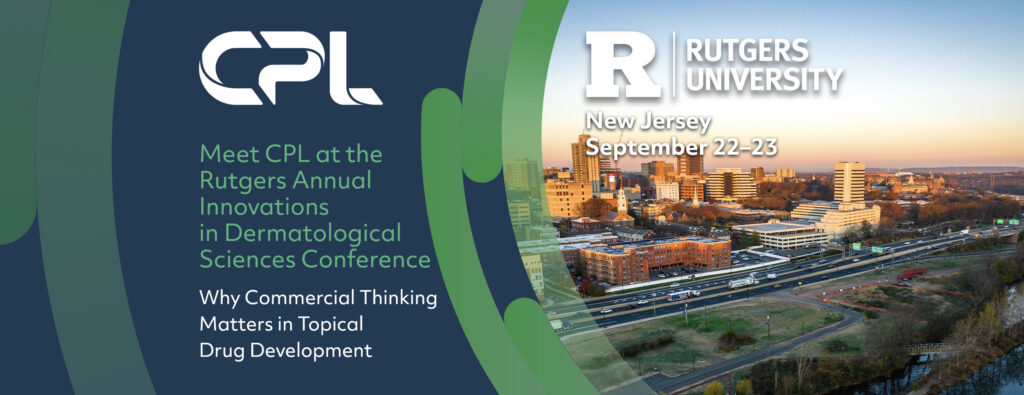
These challenges will be central to discussions at the Rutgers Annual Innovations in Dermatological Sciences Conference on September 22–23 in New Jersey. As pharmaceutical scientists, formulators, and development teams gather to discuss advances in dermatological drug development, CPL will be available to discuss practical approaches for moving topical products from formulation through commercial manufacturing.
Why Topical Drug Development Remains One of the Most Challenging Dosage Forms
Compared to many oral and injectable products, topical formulations frequently introduce greater complexity during scale-up and manufacturing. Factors such as temperature sensitivity, light sensitivity, ingredient compatibility, viscosity, and mixing behavior can significantly affect process performance.
These challenges often become apparent during technology transfer or commercial scale-up rather than during early laboratory development. Addressing them requires experience not only in formulation science but also in manufacturing processes capable of producing consistent commercial batches.
With more than 35 years of experience in topical drug development and commercial manufacturing, CPL has built development strategies around these realities. The objective is not simply to create a formulation that works in the laboratory, but to develop one that can be manufactured reliably throughout the product lifecycle.
Development Decisions Should Support Commercial Manufacturing
One of the most common reasons topical programs encounter delays is that commercial manufacturing considerations are introduced too late in development.
At CPL, commercial manufacturing is incorporated into formulation planning from the beginning of every program. Formulation scientists evaluate ingredient selection with manufacturing practicality in mind, avoiding unnecessary complexity whenever possible while maintaining product performance.
Packaging decisions are approached the same way. Whether a product is intended for tubes, airless pump bottles, sachets, or other delivery systems, development activities consider whether those packaging formats can transition efficiently onto commercial filling lines. Equipment selection, manufacturing processes, and scale-up strategies are evaluated alongside formulation development instead of after development is complete.
This integrated approach helps reduce development risk while improving the path toward clinical manufacturing and commercialization.
Cross-Functional Collaboration Supports Faster Development
Successful topical drug development depends on more than formulation expertise alone.
Each program at CPL brings together formulation scientists, analytical scientists, project managers, quality teams, manufacturing engineers, environmental health and safety specialists, and commercial operations personnel. These groups work collaboratively throughout development to identify manufacturing requirements, evaluate process risks, assess equipment compatibility, and prepare for future commercial production.
Rather than solving problems sequentially, development activities are coordinated across disciplines so manufacturing, analytical testing, quality, and operations remain aligned throughout the program.
This level of internal communication becomes especially valuable for products with challenging active pharmaceutical ingredients, alcohol-containing formulations, specialized packaging requirements, or unique manufacturing considerations.
Scientific Conversations Continue to Focus on Complex Formulations
The Rutgers Annual Innovations in Dermatological Sciences Conference brings together pharmaceutical scientists focused on advancing dermatological therapies and topical drug development. Many of the discussions center on solving technical challenges associated with formulation development, analytical testing, skin delivery, and commercialization.
CPL expects many conversations to focus on complex active pharmaceutical ingredients that present formulation challenges due to sensitivity to water, light, temperature, or other environmental conditions. Discussions are also likely to include topical reformulation strategies for improving product performance, simplifying manufacturing, or supporting lifecycle management. Development timelines will remain a priority as companies work toward aggressive clinical milestones while managing technical and manufacturing risks.
Analytical capabilities are expected to be another important topic during the conference. Pharmaceutical companies developing topical products increasingly require specialized testing to support formulation development and regulatory submissions. CPL’s skin laboratory provides capabilities including in vitro release testing (IVRT) and in vitro permeation testing (IVPT), supporting sponsors throughout topical product development.
An Integrated Partner from Development Through Commercial Manufacturing
Many pharmaceutical companies prefer to minimize technology transfers by working with a development and manufacturing partner capable of supporting the entire product lifecycle.
CPL provides integrated services that extend from formulation development through analytical support, clinical manufacturing, scale-up, and commercial production within a single facility. This continuity helps reduce communication gaps while allowing development decisions to remain aligned with long-term manufacturing objectives.
For companies developing dermatological products, having formulation, analytical testing, manufacturing, and commercial operations working together can simplify development while reducing risk throughout commercialization.
Meet CPL at the Rutgers Annual Innovations in Dermatological Sciences Conference
The Rutgers Annual Innovations in Dermatological Sciences Conference continues to attract pharmaceutical scientists focused on advancing dermatological therapies and topical drug development. As interest in innovative formulations, analytical technologies, and commercialization strategies continues to grow, the conference provides an opportunity to discuss both scientific challenges and practical manufacturing solutions.
Pharmaceutical companies attending the conference are encouraged to meet with CPL to discuss formulation challenges, IVRT and IVPT testing, specialized packaging requirements, scale-up strategies, and commercial manufacturing plans. Whether a program is entering early development or preparing for commercialization, CPL can provide technical guidance that supports a more efficient development pathway.
Schedule a meeting with CPL during the Rutgers Annual Innovations in Dermatological Sciences Conference to discuss how an integrated development and manufacturing strategy can help advance topical drug products from formulation through commercial manufacturing.