Analytical Method Development


Building Robust, Transferable Methods for Semi-Solid and Non-Sterile Liquid Drug Products
Analytical methods are foundational to developing, scaling, validating, and commercializing semi-solid and non-sterile liquid drug products. These formulations, including creams, ointments, gels, suspensions, solutions, and sprays, pose analytical challenges that require specialized expertise. CPL’s analytical method development team designs, optimizes, and validates methods that accurately assess product quality, stability, potency, performance, and batch-to-batch consistency from early development through commercial release.
Trusted Analytical Method Development for Complex Topical and Liquid Products

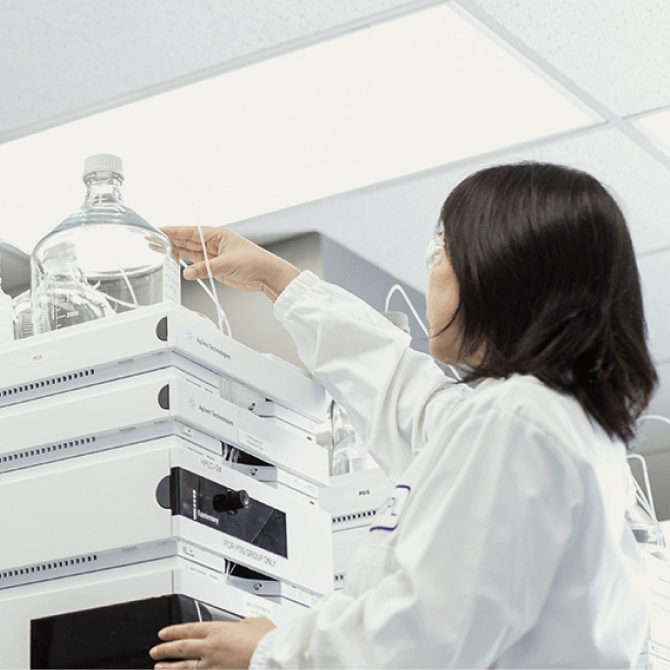
CPL develops and validates analytical methods that support the full lifecycle of semi-solid and liquid formulation drug products. Our methods are designed to be accurate, sensitive, reproducible, stability-indicating, and robust. By integrating with formulation, process, and manufacturing teams, we accelerate development, reduce rework, and ensure analytical methods align with real-world cGMP conditions.
Analytical Method Development Core Expertise
Semi-Solid Drug Products
- Viscosity, rheology, and microstructure
- Drug release characteristics via IVRT through integrated Skin Lab collaboration
- Content uniformity and homogeneity
- Assay and impurity profiles
- Skin Permeation studies via IVPT through Skin Lab collaboration
- Elemental impurities profiling
- Particle size and globule size determination
- Force degradation studies
- Freeze-thaw and heat-cool cycle studies
- Photostability studies
Semi-Solid Drug Products
- Viscosity, rheology, and microstructure
- Drug release characteristics via IVRT through integrated Skin Lab collaboration
- Content uniformity and homogeneity
- Assay and impurity profiles
- Skin Permeation studies via IVPT through Skin Lab collaboration
- Elemental impurities profiling
- Particle size and globule size determination
- Force degradation studies
- Freeze-thaw and heat-cool cycle studies
- Photostability studies
Non-Sterile Liquid Drug Products
- Assay and impurity profiles
- Dissolution testing
- Drug distribution in suspensions
- pH, viscosity, appearance, and in-use behavior
- Container-closure system integrity
- Release and stability aligned with ICH guidelines
- Forced degradation studies
- Freeze-thaw and heat-cool cycle studies
- Photostability studies
- Shaking studies for re-suspendability in suspensions
- Elemental impurities profiling
- Pump actuation, pump performance, and DDU tests
Non-Sterile Liquid Drug Products
- Assay and impurity profiles
- Dissolution testing
- Drug distribution in suspensions
- pH, viscosity, appearance, and in-use behavior
- Container-closure system integrity
- Release and stability aligned with ICH guidelines
- Forced degradation studies
- Freeze-thaw and heat-cool cycle studies
- Photostability studies
- Shaking studies for re-suspendability in suspensions
- Elemental impurities profiling
- Pump actuation, pump performance, and DDU tests
CPL Experience Spotlight
Enhancing Chromatographic Robustness through Diluent Optimization for a Peptide Gel Product
Dedicated to Excellence
from Molecule to Commercialization
CPL supports programs from early-phase through commercial launch, combining preformulation insight, robust semi-solid and non-sterile liquid development, scalable process design, and clinical and commercial manufacturing.

Pharmaceutical Development Services
Pharmaceutical Development Services
Comprehensive expertise that turns molecules into scalable, compliant, market‑ready semi-solid and non-sterile therapies.

Analytical & Product Testing
Analytical & Product Testing
Robust analytics power confident development and manufacture of topical and non-sterile liquid products.

Clinical & Commercial Manufacturing
Clinical & Commercial Manufacturing
More than three decades of GMP manufacturing experience from clinical supply through commercialization.

Packaging, Labeling & Serialization
Packaging, Labeling & Serialization
Integrated packaging, serialization, and aggregation ensure compliant, continuous commercial supply.

Semi-Solid & Non-Sterile Liquid Expertise
Semi-Solid & Non-Sterile Liquid Expertise
Pure-play CDMO for semi-solids and non-sterile liquids, with advanced micro encapsulation capabilities.

Unique Product Handling Experience
Unique Product Handling Experience
Infrastructure and expertise to manage complex, higher-risk semi-solid and non-sterile liquid products.


FAQs
-
Analytical method development defines how you assess a drug product’s quality, including factors such as potency, impurities, content uniformity, viscosity, pH, particle size, and more. For semi-solid (topical products like ointments, creams, gels, lotions) and non-sterile liquid formulations (products like suspensions, solutions, and sprays), robust methods are essential to confirm homogeneity, dose accuracy, and stability throughout shelf life. Modern guidance emphasizes building methods that are scientifically justified, robust, stability-indicating, suitable for cGMP manufacturing and process validation, and that withstand the demands of tech transfer.
-
CPL performs analytical method validation in accordance with ICH Q2(R2) and the pharmacopeial expectations of leading global regulators (USP, EP, JP), evaluating key performance characteristics such as accuracy, precision, specificity, linearity, range, detection/quantitation limits, stability, and robustness. These studies demonstrate that methods are fit for use in clinical batch manufacturing, commercial production, and stability programs. CPL’s pharmaceutical analytical services generate validation packages that support ANDA, NDA, OTC, and generic product filings and align with evolving regulatory expectations from Health Canada, FDA, EMA, and other leading regulatory authorities.
-
For semi-solid dosage forms, in vitro release testing (IVRT) and in vitro permeation testing (IVPT) have become key analytical tools. FDA SUPAC-SS and subsequent guidelines describe how IVRT/IVPT can support bioequivalence, post-approval changes, and, in some cases, help replace or reduce in vivo studies for generic topical products. CPL develops and validates IVRT methods to characterize drug release and ensure batch-to-batch consistency for creams, ointments, gels, lotions, and transdermal patches. CPL also develops IVPT methods to determine permeation of prototype formulations using human and animal skin.
-
During pharmaceutical technology transfer and scale-up, analytical development provides the data backbone for comparing lab, pilot, and commercial batches. Well-designed methods detect shifts in critical quality attributes caused by changes in facility design, equipment, processes, or other factors. CPL uses phase-appropriate analytical methods and comparability protocols to de-risk scale-up, support process validation in the pharmaceutical industry, and generate the CMC data needed for regulatory filings and lifecycle management. Furthermore, CPL uses IVRT testing for semi-solid formulations to evaluate drug release profiles and determine whether scaled-up or tech-transferred processes are successful, as required by SUPAC-SS.
Commitment.
Partnership. Legacy.
Leverage CPL’s 35 years of expertise in non-sterile liquids and semi-solids to ensure your program's success. We’ll support your product from molecule to market, or step in at any stage of its product lifecycle.