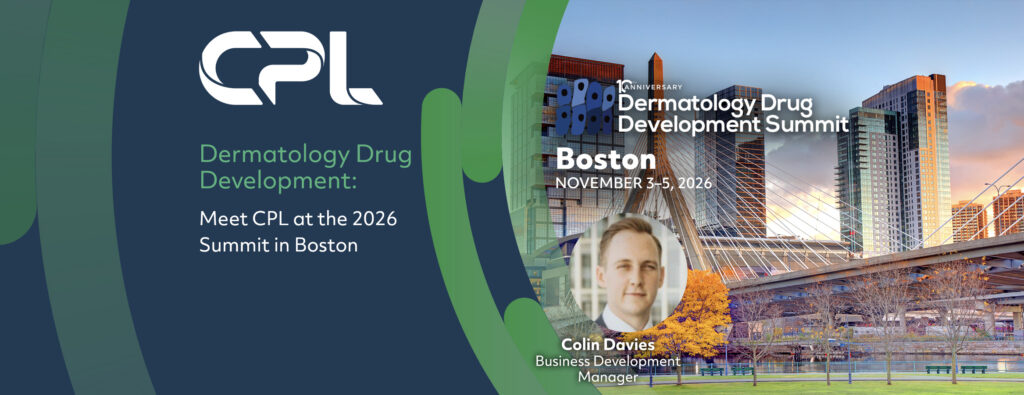
CPL will attend the 10th Annual Dermatology Drug Development Summit in Boston, Massachusetts, November 3–5, 2026, marking 10 years of participation in the conference. Business Development Manager, Colin Davies, will represent CPL, connecting with pharmaceutical and biotechnology companies developing dermatology therapies.
For sponsors developing topical drug products, demonstrating formulation performance requires more than confirming active pharmaceutical ingredient (API) content. Developers must understand how a formulation releases the API, how the drug moves through the skin, and whether it reaches the intended location.
CPL’s Skin Lab provides in vitro release testing (IVRT), in vitro permeation testing (IVPT), and skin distribution analysis to help sponsors evaluate these characteristics. Integrated with CPL’s formulation development, analytical testing, and manufacturing expertise, these capabilities support formulation selection, optimization, scale-up, and product lifecycle decisions.
Evaluating Topical Drug Performance During Development
Topical drug products face specific formulation and delivery challenges. The skin acts as a protective barrier, and the ability of an API to reach its intended site depends on the drug substance, formulation composition, and interactions between the product and the skin.
A formulation may meet conventional analytical specifications but still require further evaluation to determine whether it delivers the intended performance. Differences in excipients, drug loading, rheology, or processing conditions can affect drug release and permeation.
IVRT and IVPT provide complementary information to help address these questions.
IVRT measures the rate at which an API is released from a formulation. The results can help characterize release profiles, compare formulations, assess batch consistency, and evaluate the effects of formulation or manufacturing changes.
IVPT measures drug permeation through biological tissue over time. It can help determine how much drug passes through the tissue, how the permeation profile changes over time, and how drug distribution varies across skin layers.
These methods address different aspects of product performance. Used alongside conventional analytical testing, they provide additional data to support formulation development decisions.
How CPL’s Skin Lab Supports Topical Formulation Testing
CPL’s Skin Lab integrates specialized skin testing with pharmaceutical development expertise. Its capabilities include IVRT, IVPT, and skin distribution analysis to support the evaluation of topical and transdermal drug products.
IVRT to Evaluate Drug Release
IVRT characterizes the release of an API from a topical or transdermal formulation under defined laboratory conditions. The resulting release profile can help developers compare formulations and assess whether changes to composition or processing affect product performance.
IVRT can support development activities involving creams, gels, ointments, lotions, sprays, and transdermal products. It can also provide data for evaluating scale-up, manufacturing site transfers, post-approval changes, and batch-to-batch consistency.
CPL’s scientists develop and execute IVRT methods with consideration for the formulation’s characteristics and the objectives of the study. Method design is important because factors such as receptor medium, membrane selection, sampling conditions, and analytical sensitivity can influence the quality and interpretation of results.
IVPT to Evaluate Drug Permeation
IVPT evaluates how an API moves through biological tissue. Testing with skin or mucosal tissue in diffusion-cell systems can help measure drug permeation and generate profiles that support formulation development.
The results can help sponsors compare prototypes, investigate the effects of formulation changes, and assess whether a product delivers the API to the intended skin layer. IVPT can also provide information about drug distribution within the skin, helping teams evaluate formulations with different delivery characteristics.
During early formulation development, these data can help narrow a group of candidates and identify formulations that warrant further investigation. For later-stage programs, IVPT can support the assessment of formulation changes and product performance.
CPL’s IVRT and IVPT expertise connects skin performance data with the decisions sponsors make throughout topical drug development.
Skin Distribution Analysis to Understand Drug Location
The amount of drug released from a formulation does not necessarily establish where the API is located within the skin. Skin distribution analysis provides additional information about drug presence in different skin layers and the remaining material on the skin surface.
CPL’s Skin Lab can evaluate drug distribution in excised human or animal skin to support formulation development, drug screening, and penetration studies.
Understanding drug distribution can be important when a product is designed to deliver an API locally rather than systemically. These studies can help developers investigate formulation performance and determine whether additional optimization or testing is warranted.
Using Skin Testing to Guide Formulation Development
Skin testing provides the greatest value when the results inform practical development decisions. IVRT, IVPT, and skin distribution analysis can help identify performance differences between formulations that may not be apparent from conventional physical or chemical testing alone.
For example, two formulations may demonstrate acceptable API content and physical characteristics but produce different release or permeation profiles. IVRT can help identify differences in release behavior, while IVPT can provide information about drug movement through biological tissue.
The results can guide decisions involving excipient selection, drug loading, rheology, and process parameters. They can also help development teams determine which formulation candidates should advance to further characterization and testing.
CPL integrates its Skin Lab capabilities with formulation development, allowing testing results to inform subsequent formulation and process decisions. This coordination helps connect performance data with the technical adjustments needed to advance a product.
CPL’s approach is relevant to sponsors developing creams, gels, ointments, lotions, and other topical formulations that require careful evaluation of drug release, permeation, and distribution.
Connecting Skin Lab Testing With Scale-Up and Manufacturing
Formulation development does not end when a candidate demonstrates promising laboratory performance. The product must also be suitable for manufacturing at larger scales, with appropriate controls to maintain its quality and performance.
Changes in batch size, equipment, processing conditions, or manufacturing location can affect formulation characteristics. Skin testing and analytical data can help sponsors assess whether changes require further investigation and support decisions about formulation or process optimization.
CPL combines early-stage formulation expertise with process development, analytical testing, scale-up, technology transfer, and clinical and commercial manufacturing. This integrated model allows product performance and manufacturability to be considered together as a program advances.
CPL’s semi-solid formulation development capabilities support the development and manufacture of topical products, including creams, gels, and ointments. By coordinating formulation and manufacturing expertise, CPL can help sponsors address development requirements while considering the needs of later-stage production.
Skin Lab testing also supports programs already in development or manufacturing. Sponsors can engage CPL for specialized testing even when other parts of the development program are managed by a separate organization.
Meet CPL at the 10th Annual Dermatology Drug Development Summit
CPL will attend the 10th Annual Dermatology Drug Development Summit in Boston, Massachusetts, November 3–5, 2026. Business Development Manager, Colin Davies, will represent CPL, connecting with pharmaceutical and biotechnology professionals working across dermatology drug development.
CPL has attended the summit for 10 years, using the event to maintain industry relationships, connect with new companies, and discuss evolving development and manufacturing priorities. This continued participation reflects CPL’s engagement with the challenges facing sponsors as they advance topical drug products.
Attendees can connect with Colin to discuss IVRT and IVPT study requirements, formulation screening, skin distribution analysis, method development, scale-up, and manufacturing needs. Whether a sponsor is evaluating an early formulation concept or preparing to advance an established product, CPL can discuss the technical requirements and identify relevant services.
Contact CPL to schedule a meeting with Colin Davies during the Dermatology Drug Development Summit. Discuss current project needs and learn how CPL’s Skin Lab, formulation development, and manufacturing capabilities can support informed development decisions and help advance topical drug products toward commercialization.